
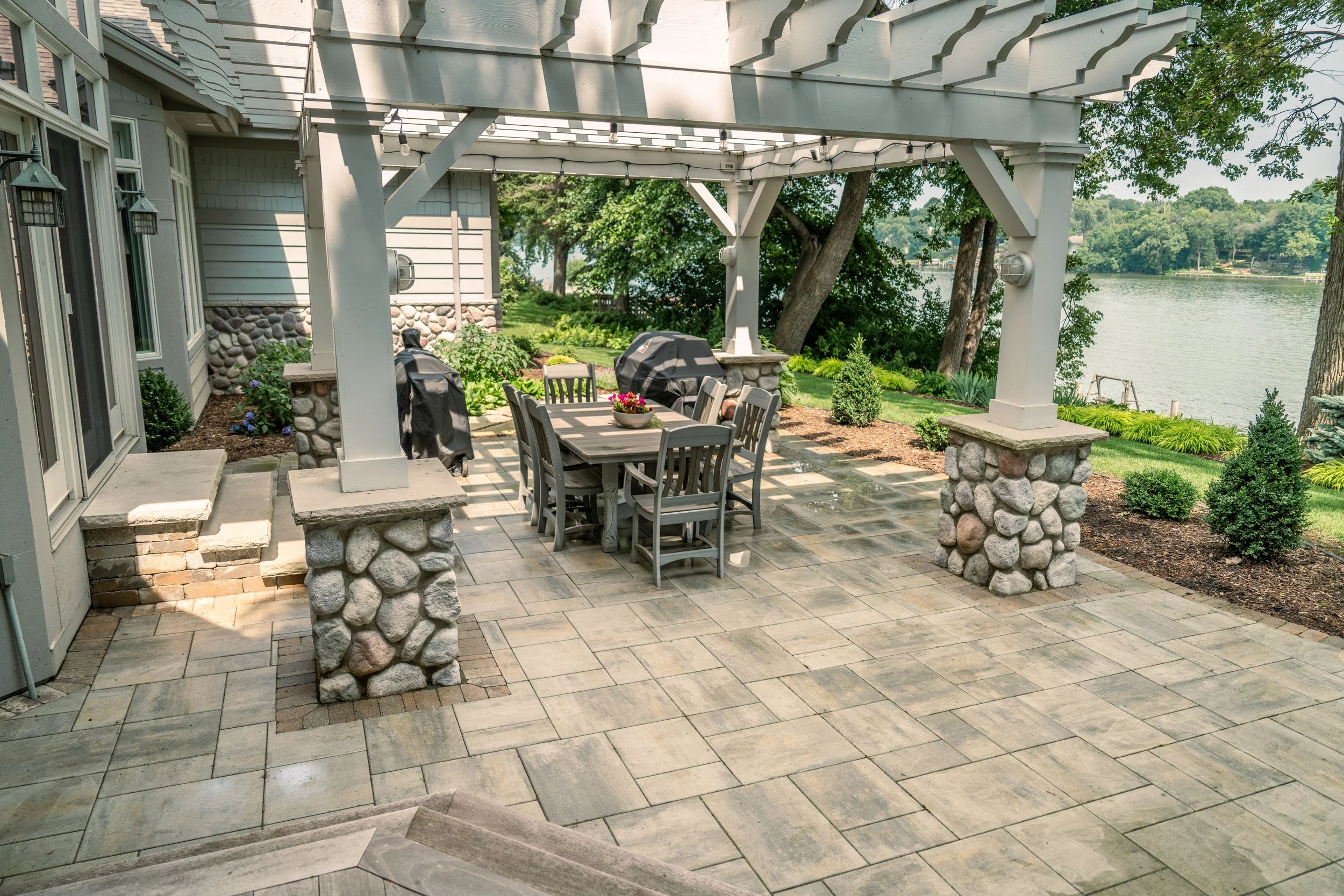
Choosing a masonry contractor in Appleton, WI is largely a question about winter. Stone and block do not fail in July. They fail over several Februaries, as water that got into the structure freezes, expands and works the assembly apart a fraction at a time.
Van Zeeland Nursery & Landscape has served the area for more than 90 years, growing from a small nursery into a full-service landscape company with an 18-acre garden center, so the stone and the planting around it are specified by one team.
Most of what follows is about keeping water out of the wall.
Related: Transform Your Backyard With Custom Pavilions in Appleton, WI
What Does Freeze and Thaw Actually Do to a Stone Wall?
Freeze and thaw pushes a stone wall apart from the inside. Water held in a joint or behind a face expands as it turns to ice, pressing outward on whatever contains it, and in this part of Wisconsin a single winter delivers dozens of those cycles rather than one long freeze.
The damage is cumulative and quiet. A wall that looked sound in year three can show open joints and a leaning face by year eight, and the cause was usually settled when it was built.
Where Does the Water in a Retaining Wall Come From?
The water in a retaining wall mostly comes from behind, not from rain on the face. Soil holds water against the back of the wall, and if that water has nowhere to go, it freezes in place and pushes.
That is why drainage stone, a drain line and a geotextile separating the two matter more than the material anyone sees.
A wall without them is holding back saturated soil every spring, and no amount of face work fixes that later.
How Deep Does a Masonry Wall Base Need to Go?
A masonry wall base needs to sit below the depth that freezes, or on a base engineered to move as a unit.
A structure founded in the frost zone lifts in winter and settles in spring, and over a few years those movements show up as cracked joints and stepped coursing.
For freestanding and seating walls, this is the single most consequential decision on the job, and it is made before any stone is set. Proper base preparation is what lets the rest of the wall do its job through a Fox Valley winter.
Related: Built to Last: Retaining Wall Projects That Shape Beautiful Landscapes in Appleton, WI & Neenah, WI
What Is the Difference Between Mortared and Dry-Laid Stone Walls?
The difference between mortared and dry-laid stone walls is how each handles movement. A mortared structure is rigid, so it depends on a foundation that does not shift and on joints that shed water rather than hold it.
Segmental and dry-laid walls flex slightly instead, with the units interlocking and the drainage layer doing the work behind them. Neither approach is a shortcut, and the site usually decides which one is appropriate.
Why Does Cap Detailing Matter So Much on a Stone Wall?
Cap detailing matters because the top of a wall is where water gets in. A cap that sheds water away from the joints keeps the interior dry, while a flat cap with open seams funnels meltwater straight down into the structure.
Cap work is the detail most often economized on, and it is the one that decides how the wall ages. The same logic applies to steps and to the top course of a seating wall around a patio or fire pit.
When Should Masonry Work Be Scheduled in Appleton?
Masonry work in Appleton is best designed through winter and built once the ground opens. Mortar and compaction both behave differently in the cold, so the construction season here is bounded by the weather rather than by preference.
Booking the design now usually secures a better spot in the spring or early summer schedule. It also means material selection happens while there is time to look at samples in person, including the hardscape and planting selection at our garden center.
Walk Your Appleton Site Before the Ground Freezes
A visit now settles grade, drainage and where a wall should actually sit, which is harder to judge under snow. Our retaining and seating walls are built with proper drainage, base preparation and premium materials like Unilock across Appleton, Green Bay and the wider Fox Valley.
Van Zeeland Nursery & Landscape builds the drainage behind a wall before anyone looks at the face. Schedule your retaining wall consultation with Van Zeeland Nursery & Landscape
In Summary
Can an existing stone wall be repaired rather than rebuilt?
An existing stone wall can sometimes be repaired rather than rebuilt, depending on the condition of the base and drainage. A wall that has lost its face but sits on a good foundation can often be reset, while one that is leaning because of frost or water pressure usually needs rebuilding from the base.
How tall can a retaining wall go before engineering is required?
The height a retaining wall can reach before engineering is required varies by municipality in the Fox Valley. Taller walls generally need a stamped design along with a permit, so the local requirement is worth checking before the design is finalized.
Do stone walls need sealing in a Wisconsin climate?
Stone walls do not depend on sealing for structural performance in a Wisconsin climate, because that comes from the base and drainage. Sealing is sometimes used on mortared work to reduce staining and efflorescence, and it is a finish decision rather than a durability one.
How does Van Zeeland Nursery & Landscape build walls for freeze-thaw cycles?
Van Zeeland Nursery & Landscape builds retaining walls with proper drainage, base preparation and frost-resistant materials to stand up to Northeast Wisconsin’s freeze-thaw cycles. The goal is to keep water from collecting behind the wall, where it would freeze and push the structure out of line.
Related: Transform Your Outdoors With Landscape Design and Nursery Services in Oshkosh, WI & Green Bay, WI
